
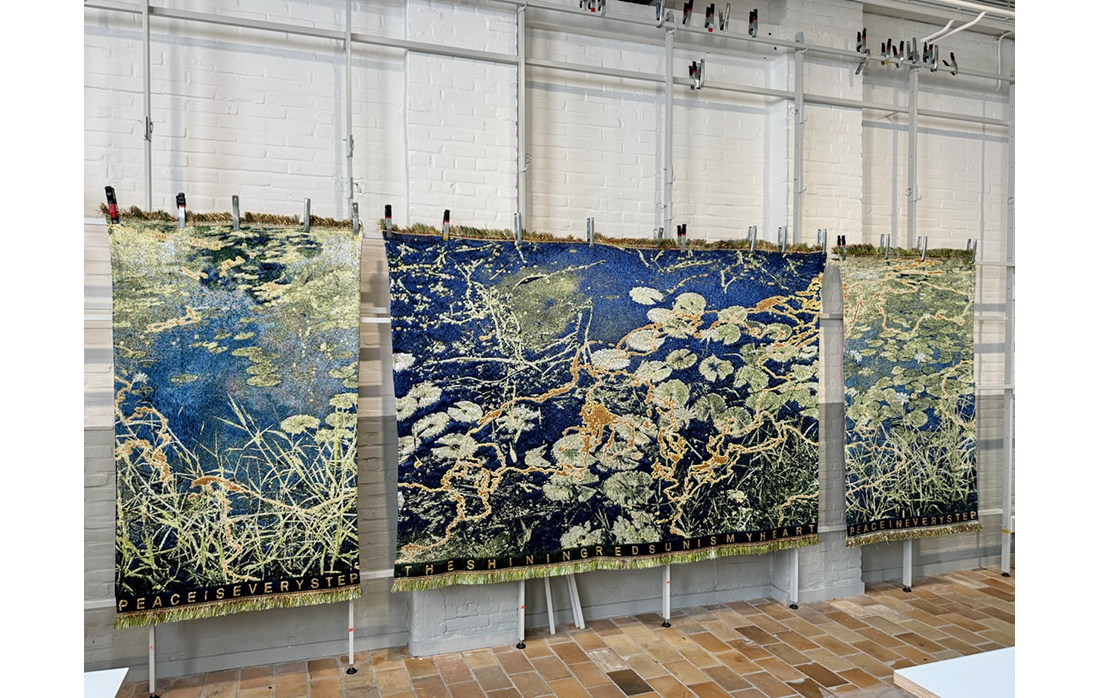
‘Steps in Peace’ is a triptych jacquard tapestry which resulted from a carte blanche commission from the Musée départemental Albert Kahn to develop a work in the context of the exhibition ‘Choosing Peace. Albert Kahn’s fight’.
Connected underwater by a shared root system, their gentle swaying evokes that of the continents on a world map viewed from the North Pole, thereby shifting the focus away from the Western worldview.
‘Steps in Peace’ is an invitation not to view peace as an end in itself, but as an active, everyday practice.”
Texte original
Laurence Aëgerter a ainsi choisi pour la commande du musée le motif des nénuphars de son étang.
Reliés sous l’eau par un système racinaire commun, leurs flottements évoquent celui des continents sur un planisphère vu depuis le pôle Nord, décentrant ainsi le regard de la vision occidentale du monde.
Laurence Aëgerter
The Musée départemental Albert Kahn in Paris has given me a carte blanche commission to create a new artwork to be presented as the finale of the exhibition ‘Choisir la paix’. This exhibition is dedicated to the life’s work of the visionary pacifist and humanist Albert Kahn.
The commission is the result of a three-year dialogue with curators Anthony Petiteau and Clément Poché, combined with several visits to the museum and the archive. To carry forward Kahn’s pacifist legacy in a contemporary way, I have designed a monumental tapestry in three panels: ‘Steps in Peace’.
The pressing situation of our times, in which more than 60 armed conflicts are raging across the world and nations are once again prioritizing their military might above all else, means that this commission to create a work of art about peace feels to me like a special challenge and honor.
The French banker Albert Kahn (1860–1940) was a visionary philanthropist who devoted his fortune and his life to promoting world peace. Kahn established educational and research centers, student exchange programs and forums for intellectual exchange.
His monumental project ‘Les Archives de la Planète’ (including 70,000 colour photographs on glass plates taken in more than fifty countries) is both a historical document and a humanistic gesture, aimed at laying the foundations for intercultural understanding and brotherhood.
I am deeply moved by Kahn’s conviction and determination. Albert Kahn’s belief in humanity and the importance of education and imagination in transcending conflicts is closely aligned with my artistic practice. In my work, I explore how images shape our view of the world, and how imagination can open up space for different perspectives and ways of thinking.
The artwork consists of a monumental three-part tapestry, seven meters wide and 2.5 meters high. The left and right panels are each 160 cm wide; the central panel measures 380 cm. The scale of the work means that the viewer must physically engage with it; one does not merely look at it but finds oneself right in the midst of it.
At the heart of Kahn’s philosophy lies the garden as a metaphor: a place where inner peace is nurtured and from which a broader, global peace can emerge. The composition of the tapestry is based on two photographs from ‘Les Archives de la Planète’, specifically of the pond in Albert Kahn’s garden. The sky is reflected beneath the water’s surface, creating an inverted depth – an experience that invites one to slow down and engage in self-reflection. Each water lily forms an island, seemingly autonomous, yet invisibly connected beneath the water via a shared root system.
Just as water lilies are rooted, so too are the continents connected by an invisible primordial magma, constantly in slow motion. Borders shift, meet and drift apart – physically over millions of years, socially and politically often within a single generation.
Superimposed upon this is a drawing of the outline of the world map, in an unusual perspective: viewed from the North Pole.
This perspective, also familiar from the United Nations logo, challenges the Western-oriented world view and puts the hierarchies of center and periphery into perspective.
The water lilies from Albert Kahn’s garden function in this artwork as ‘stepping stones’ for peace. Beneath the tapestry runs a three-part text drawn from the work of the Vietnamese Buddhist monk and Zen master Thich Nhat Hanh (1926–2022), an influential peace activist and spiritual leader. The third text is my own addition. The phrase ‘Every step in peace’ serves as an invitation: not to regard peace as an end in itself, but as an active, daily practice.
Nederlands
Het Musée départemental Albert Kahn in Parijs heeft mij een carte blanche-opdracht gegeven om een nieuw kunstwerk te realiseren dat wordt gepresenteerd als slotstuk van de tentoonstelling ‘Choisir la paix ‘. Deze tentoonstelling is gewijd aan het levenswerk van de visionaire pacifist humanist Albert Kahn.
De opdracht is het resultaat van een drie jaar durende dialoog met de conservatoren Anthony Petiteau en Clément Poché, gecombineerd met meerdere bezoeken aan het museum en het archief. Om het pacifistische gedachtegoed van Kahn op een hedendaagse manier voort te zetten, heb ik een monumentaal wandkleed in drie luiken ontworpen: Steps in Peace.
De prangende situatie in ons huidige tijdperk, waarin meer dan 60 gewapende conflicten in de wereld woeden en de landen hun krijgsmacht weer als de hoogste prioriteit stellen, maakt dat deze opdracht om een kunstwerk over de vrede te realiseren voor mij voelt als een bijzondere uitdaging en eer.
De Franse bankier Albert Kahn (1860–1940) was en een visionair filantroop die zijn fortuin en leven wijdde aan het bevorderen van wereldvrede. Kahn initieerde onderwijs en onderzoekscentra, studie-uitwisselingen en intellectuele ontmoetingsplaatsen.
Zijn monumentale project ‘Les Archives de la Planète’ (o.a. 70.000 kleurenfoto’s op glasplaat in meer dan vijftig landen gefotografeerd) vormt zowel een historisch document als een humanistisch gebaar, met als doel de basis te leggen voor intercultureel begrip en broederschap.
Ik ben diep geraakt door Kahns overtuiging en daadkracht. Albert Kahns geloof in de mensheid en het belang van onderwijs en verbeelding om conflicten te overstijgen sluit nauw aan bij mijn artistieke praktijk. In mijn werk onderzoek ik hoe beelden onze kijk op de wereld vormen, en hoe verbeelding ruimte kan openen voor andere perspectieven en denkpatronen.
Het kunstwerk bestaat uit een monumentaal driedelig wandkleed van zeven meter breed en 2,5 meter hoog. De linker- en rechterpanelen zijn elk 160 cm breed; het centrale paneel meet 380 cm. De schaal maakt dat de beschouwer zich lichamelijk tot het werk moet verhouden, men kijkt er niet alleen naar maar bevindt zich er middenin.
Aan de kern van Kahns gedachtegoed staat de tuin als metafoor: een plek waar innerlijke vrede wordt gekoesterd en waaruit een bredere, mondiale vrede kan ontstaan. De compositie van het wandkleed is gebaseerd op twee foto’s uit ‘Les Archives de la Planète’, namelijk van de vijver in de tuin van Albert Kahn. Onder het wateroppervlak weerspiegelt de lucht zich, waardoor een omgekeerde diepte ontstaat, een ervaring die uitnodigt tot vertraging en zelfreflectie. Elke waterlelie vormt een eiland, ogenschijnlijk autonoom, maar onder water onzichtbaar verbonden via een gezamenlijk wortelstelsel.
Zoals de waterlelies geworteld zijn, zo zijn ook de continenten verbonden door een onzichtbaar oermagma, voortdurend in langzame beweging. Grenzen verschuiven, raken elkaar, drijven uiteen, fysiek over miljoenen jaren, sociaal en politiek vaak binnen één generatie.
Daaroverheen ligt een tekening van de contourlijnen van de wereldkaart, in een ongebruikelijk perspectief: gezien vanuit de Noordpool.
Dit perspectief, ook bekend van het logo van de Verenigde Naties, doorbreekt het westers georiënteerde wereldbeeld en relativeert hiërarchieën van centrum en periferie.
De waterlelies uit de tuin van Albert Kahn functioneren in dit kunstwerk als ‘stepping stones’ for peace. Onder het wandkleed loopt een driedelige tekst ontleend aan het werk van de Vietnamese boeddhistische monnik en zenmeester Thich Nhat Hanh (1926–2022), een invloedrijke vredesactivist en spiritueel leider. De derde tekst is mijn eigen toevoeging. De zin ‘Every step in peace’ fungeert als uitnodiging: vrede niet te beschouwen als eindpunt, maar als een actieve, dagelijkse praktijk.