
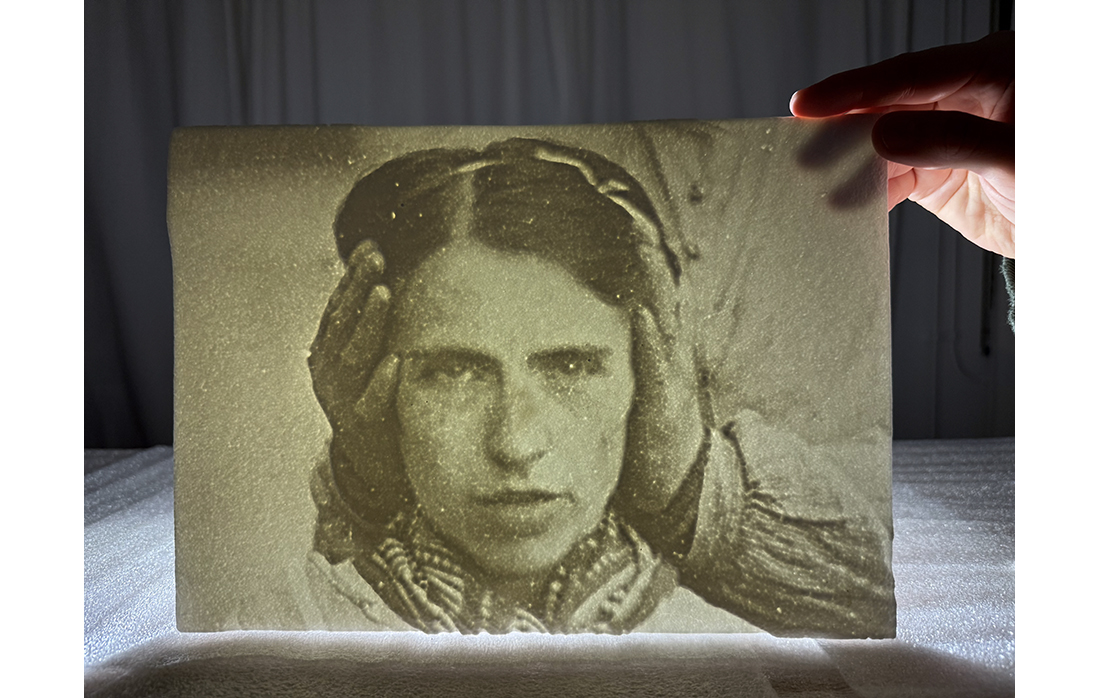
‘Poor Maria’, 2026
“In the three panels, each comprising several lithophanes , the artist evokes the figure of Maria who appears in Laurence Sterne’s classic work of English literature, *The Life and Opinions of Tristram Shandy, Gentleman* (1759–1767). Over the years, Maria has become the popular archetype of Melancholy, giving rise to numerous pictorial and literary interpretations.
Laurence Aëgerter, in turn, revisits this figure, who has been driven ‘mad’ by Love—a fate against which one is powerless—yet who seems to live out her despair serenely in the shade of a tree, alongside a dog or a goat, appearing to converse with the stream—both a purifier and a source of chaos—that flows at her feet.
The artist selects, from the photographic archives of the San Clemente asylum, portraits of women suffering from the same symptoms, and from the Archives of the Planet, elements of the setting which she assembles around the portraits like the set pieces of a painting.
The ambivalence of emotions – madness, despair, serenity, acceptance – is conveyed through the technique of lithophany. With the lights off, the lithophanes are opaque; the forms are raw and indistinct, as if a storm were brewing, just waiting to break. This effect is reinforced by the cold, metallic frames. When lit, the intensity of the gazes or the cascading waterfalls is softened by the shades of grey and the gentle light from the light source.”
Sylvain Besson, Directeur des collections, musée Nicéphore Niépce
Texte original
“Les trois panneaux composés chacun de plusieurs lithophanies, Poor Maria, témoignent pour leur part de la complexité de la démarche de l’artiste.
Elle y évoque la figure de Maria apparue dans le classique de la littérature anglaise Vie et opinions de Tristram Shandy, gentilhomme (1759-1767) de Laurence Sterne.
Au fil des années, Maria est devenu l’archétype populaire de la Mélancolie, donnant lieu à de multiples interprétations picturales et littéraires.
Laurence Aëgerter reprend à son tour cette figure, devenue « folle » par Amour, pour laquelle on ne peut rien mais qui semble vivre sereinement son désespoir à l’ombre d’un arbre, aux côtés d’un chien ou d’une chèvre, semblant dialoguer avec le ruisseau, à la fois purificateur et source de chaos, qui passe à ses pieds.
L’artiste choisit au sein des fonds photographiques de l’asile de San Clemente des portraits de femmes en proie aux mêmes symptômes et dans les Archives de la Planète les éléments du décor qu’elle assemble autour des portraits comme les pièces de décor d’un tableau.
L’ambivalence des sentiments – la folie, le désespoir, la sérénité, l’acceptation – est restituée par le procédé de lithophanie. Éclairage éteint, les lithophanies sont opaques, les formes sont brutes, indistinctes, comme si une tempête couvait et ne demandait qu’à surgir. Cet aspect est renforcé par l’encadrement froid, métallique. À la lumière, la violence des regards ou des chutes d’eau se trouve atténuée par les niveaux de gris et l’éclairage doux de la source lumineuse.”
Laurence Aëgerter
Following the creation of my monumental textile work ‘Epic of the Mind’ (2023), ‘Poor Maria’ marks the next new step, exploring the marvellous human spirit – at once so fragile and yet so resilient. ‘Poor Maria’ is an iconic figure from the famous, and at the time phenomenally popular, works of the 18th-century English writer Laurence Sterne*. Through his novels, ‘Poor Maria’ became a popular archetype for ‘melancholy’, that is to say, clinical depression.
An intense heartbreak has plunged ‘Poor Maria’ into a state of profound alienation from the world.The reader, just like the main character in the book, is struck by feelings of empathy for her, but also by a painful sense of helplessness; ‘Poor Maria’, it turns out, has found a certain harmony amidst all her confusion and is able to enchant people.She spends her life sitting under a tree by a stream, playing the flute in the company of her little goat (later replaced by a little dog). Countless paintings, prints and sculptures of ‘Poor Maria’ have been produced in England.
I find the immense popularity of this allegorical female figure representing melancholic madness a fascinating and inspiring phenomenon. How can someone in ‘Poor Maria’s’ situation be helped? Is society responsible for her mental state?
The complex challenge of human existence, ‘la Condition Humaine’, is a harsh reality which, in varying contexts and degrees, is a universal, shared experience.
The story of ‘Poor Maria’ and the issues it raises are timeless in nature; they are therefore also highly topical.
*Inspired by Laurence Sterne (1713–1768), *The Life and Opinions of Tristram Shandy, Gentleman* (1759) and *A Sentimental Journey through France and Italy* (1768).